Eugene Forsey Liberal

Saturday, April 10, 2010

Gardner & His Ottawa Ilk Are Orangemen Bigots (Unknowingly?)

What I said to a supposed Liberal who's a fan of Gardner's latest - Bullshit. It's always loser anglos who are too lazy, selfish or stupid who write this shit. As Trudeau said: "Le Canada sera bilingue ou il ne sera pas." Obviously, not everyone, but institutionally, yes. I've spent many long difficult years fighting for Canada, federalism and minorities in QC, but if one thing could make me a separatist, like pretty much everyone else, it would be such a stupid bigoted view taking hold. Bigoted because when there is 3-1 to 4-1 disproportion of majority to minority, and said minority in mostly concentrated in one geo-political space, it is completely obvious that without both rules and ethos that make our institutions and workings bilingual, it will inevitably be the large majority that will win out, and by a margin larger than their proportion of the population, AS WAS THE CASE PRE-TRUDEAU AND THE OFFICIAL LANGUAGES ACT. And the geographically concentrated minority will act logically, protect their interests, and separate, in such a case. When anglos say this, what they are really advocating is affirmative action for their own large majority. So whatever egalitarian fairytale of principles they may tell themselves, they are advocating the advancement of the majority at the expense of the minority, as the real-world outcome.

Very similar to the Reaganite rhetoric and policies that hid anti-black, anti-hispanic anti-minorities policies behind the pretext of simple absolute egalitarianism of opportunity, conveniently ignoring the real-world context and the fact that the minorities, far from having the same equality of opportunity, are heavily disadvantaged and thus such policies could only entrench and worsen the outcome differences between whites and blacks/hispanics, AS THEY DID! What Gardner & you are advocating is that we return to the pre-1967 situation where there was a massive under-representation of francophones in federal institutions, and those few were almost all in the most menial positions, tea ladies, cleaners and the like. Gardner and your position is Orange Order intolerance dressed up for modernity in the robes of imbecilic decontextualised egalitarianism. Which should come as no surprise from a Carleton student as Carleton was founded so anglo protestants from the Valley could avoid having to mingle with all those Frogs and Papists at the University of Ottawa (ever ask yourself why Carleton wasn't just a 2nd UofO campus?).

And Gardner, Ottawan, in this column, is redolent of that Orangeman bigotry that has been and continues to be the blight of the Ottawa Valley: see Cheryl Gallant's contributions to the House debate during the Coalition "crisis". A question: 40 years after the Official Languages Act, in a country close to 1/4 francophone, what percentage of the Anglo Press Gallery are bilingual? And how does that affect their coverage? Poser la question, c'est y répondre. Finally, if these are your views, are you sure you're a Liberal? Randy Hillier's Ontario Landowners Association is always looking for more cranks, kooks and bigots - maybe you should check them out.

Friday, April 09, 2010

The Provocative Mr. Silver

Silver missed his calling, he would have been a great headline writer for the Toronto Sun. Always smart, always fun, and often provocative. Today, The Canada Health Act is dead. Knowing Silver, the intent of the headline and apparent conclusion may not be what it seems. Maybe yes, but I wouldn't have been surprised to see the whole thing end with a ";)". Perhaps Silver hasn't been able to find a paper copy of Macleans and is only aware of Coyne's piece. Were that the case, I would strongly suggest that he and others find themselves a paper copy and read Geddes vital piece. I'll link to both Coyne's and Geddes' when they are both up (nb. generally, if you're not reading Geddes, you're snoozing & losing). Sufficeth to say, the game is afoot. Silver perhaps does not know that the hypothetical user-fee would only come into effect, supposedly, in 2012-2013 at the earliest, and probably not until 2013-2014. Supposedly. I am sure that he and others remain innocently unaware of any reminders of hard facts and considered reflections: "Quant au ticket modérateur, il faudra voir si les avantages potentiels d'un tel système valent les coûts, la complexité et les risques de sa mise en place."

But innocent as Silver is, and as unlike him as it would be, on the off-chance that he was implying that Iggy & the LPC don't need to denounce the airy hypothesis and alienate Charest & the PLQ right away, losing their material support during the Federal election that will precede by quite a bit the introduction of any hypothetical user-fee, that "there's many a slip 'twixt cup and lip", and one can wait until the QC politics work themselves out and the final proposals are brought forward, whenever that is, however far away, before finally taking a hard position, I would respond, should Silver be taking such an position, despite his innocent, unworldly nature, that there is of course the simple matter of right & wrong, not just on health care & Liberal principles re. society, but as regards coherent federalism vs. asymmetrical chaos (a question about which I know he is ignorant and apathetic, carefree even), in addition to the probability of someone else waking up and eating our lunch. But as I know Silver is an innocent idealist with no idea of the machinations of politics nor the workings of the media and public opinion, and never tries to influence these in any clever way, I shan't bother, of course.

;)

PS. In unrelated news - McGuinty on health care user fees: no evidence that they work

Thursday, April 08, 2010

Iggy, Don't Piss Us Off - Your Health Care Line Is BS

I read the Iggy speech very carefully and checked the media reports. He is trying to thread a needle that isn't there (relevant passages & analysis at bottom). He needs to stand up for ACCESSIBILITY REGARDLESS OF INCOME, not this BS "universality" escape clause. Parse his remarks and they could be interpreted either for or against user fees & regressive taxation. He's chicken to criticise Charest (or he agrees) and he's chicken to stand against Medicare (or he believes in it, but chicken to say so). But there's no way around this, there's no Mac Kingian obfuscation possible. You're either with the counterproductive user-fee & regressive taxation idiots, or you're with the forces of productive truly accessible universal health care. You're with us or against us. I should note, for the ignorant, that the reason the UK has always made their health care "freely" available for all, recently landed immigrants & refugees as well as anyone else (no three month waits!) is because of the danger of communicable diseases, and costs: what happens if someone has some Ebola or something, but didn't get it checked out as early as possible because they were poor and wanted to avoid the user fee? Think, people, think!!!
GPs win care fight for asylum seekers

The government is ready to scrap controversial plans to clamp down on so-called 'health tourism' among asylum seekers, following a revolt by doctors.

Ministers had threatened to withdraw the right to free GP treatment from asylum seekers whose claims were rejected, forcing them to pay for care privately or go without in all cases except emergencies. However, doctors have argued the move would be unethical and potentially illegal, with some saying they would treat patients regardless of any new rules.
(...)
Ministers first proposed denying free primary care from GPs four years ago, driven by concerns about the cost of health tourism. But a decision has been repeatedly delayed, amid objections from doctors and refugee organisations, who argued that it would be inhumane, could encourage the spread of infectious diseases and would put A&E wards under strain as overseas patients whose conditions had gone untreated developed life-threatening complications.

Iggy Speech - Relevant Section
La semaine dernière, quand on m’a demandé ce que je pensais du budget du premier ministre Charest, j’ai rapidement reconnu qu’il agissait pour essayer de résoudre un très gros problème : celui du financement du système de santé dans un contexte de vieillissement de la population.

Il faut être ouvert à ce que les provinces puissent expérimenter, dans le cadre des grands principes de la loi canadienne sur la santé. Il faut protéger l’accès au système de santé.

Le gouvernement du Québec le sait et a indiqué qu’il allait situer sa réforme à l’intérieur des paramètres de la loi canadienne. Je salue le fait qu’il lance le débat. C’est de là que vient le progrès.

Lancer un débat, oui, mais un débat qui respecte le grand principe de notre système : de garantir l’accès universel aux soins de santé. Ce principe est l’épine dorsale de la citoyenneté canadienne.

Est-ce que M. Harper entend respecter ce principe? Son silence est révélateur.
You see, the problem is he says "access must be protected", "QC is saying it'll reform system within parameters of Canada Health ACt (untrue), "must respect universal access as basic principle' and opposes his support for "universal access" with Harper's silence. BUT ANYONE WHO FOLLOWS THESE THINGS KNOWS IT'S POSSIBLE TO CLAIM UNIVERSAL ACCESS WHILE CHARGING USER FEES. We all have universal access to McDonald's, theoretically, it's just that we need to pay for food and drink...so if you don't have the money, you can't. There is a huge difference between the principle of universality and accessibility, and Iggy, you're not fooling anyone. Speak up for accessibility, as defined by the Canada Health Act, or suffer the consequences.
CHA
Accessibility
12. (1) In order to satisfy the criterion respecting accessibility, the health care insurance plan of a province
(a) must provide for insured health services on uniform terms and conditions and on a basis that does not impede or preclude, either directly or indirectly whether by charges made to insured persons or otherwise, reasonable access to those services by insured persons;
(b) must provide for payment for insured health services in accordance with a tariff or system of payment authorized by the law of the province;
(c) must provide for reasonable compensation for all insured health services rendered by medical practitioners or dentists; and
(d) must provide for the payment of amounts to hospitals, including hospitals owned or operated by Canada, in respect of the cost of insured health services.
And this is translated into law the following way:
EXTRA-BILLING AND USER CHARGES

Extra-billing

18. In order that a province may qualify for a full cash contribution referred to in section 5 for a fiscal year, no payments may be permitted by the province for that fiscal year under the health care insurance plan of the province in respect of insured health services that have been subject to extra-billing by medical practitioners or dentists.
1984, c. 6, s. 18.
User charges

19. (1) In order that a province may qualify for a full cash contribution referred to in section 5 for a fiscal year, user charges must not be permitted by the province for that fiscal year under the health care insurance plan of the province.

Deduction for extra-billing

20. (1) Where a province fails to comply with the condition set out in section 18, there shall be deducted from the cash contribution to the province for a fiscal year an amount that the Minister, on the basis of information provided in accordance with the regulations, determines to have been charged through extra-billing by medical practitioners or dentists in the province in that fiscal year or, where information is not provided in accordance with the regulations, an amount that the Minister estimates to have been so charged.
Deduction for user charges

(2) Where a province fails to comply with the condition set out in section 19, there shall be deducted from the cash contribution to the province for a fiscal year an amount that the Minister, on the basis of information provided in accordance with the regulations, determines to have been charged in the province in respect of user charges to which section 19 applies in that fiscal year or, where information is not provided in accordance with the regulations, an amount that the Minister estimates to have been so charged.

Duceppe: Clifford Lincoln's Illegitimate Son? Dion's Twin?

Duceppe in St. John's: "Rights are rights are rights."

L'Irrationalité linguistique, prise milliard; PQ Needs Prozac; Curzi = triste déception

1. Il résuma la situation : @partiquebecois "on voulait faire des francophones bilingues avec les immigrants, ils sont devenus des anglophones bilingues" THE HORRORS!!!

2. Le métro de Longueuil est bien plus près du centre-ville que le centre d'achats Fairview.

3. Et si on rendait la consommation du Prozac obligatoire pour tous les membres du PQ? Quel pourcentage de nos problèmes factices seront ainsi résous, 99%? 95%? 90%? Pas moins de 90%, selon moi, et je dirai plutôt 98% (il reste 1% pour l'ADQ, 1% pour QS et 1% pour le PLQ).

4. La langue d'usage est tout ce qui compte (voir 1). C.-à-d., pendant les heures de travail, disons, genre 8h-19h, à Mtl, est-ce qu'on est servi en français / peut-on se faire servir en français? La réponse c'est un très fort oui. Qu'est-ce qu'on a à foutre de la langue parlée en famille ou entre amis ou entre connaissances? Selon cette logique, va-t-on commencer à se soucier des différents accents des francophones, leur vocabulaire, etc.? Et si le monde à Mtl le jour vient de Longueuil, pis encore? Une banlieue sur l'île mais loin dans le West Island est-elle intrèsequement supérieure à celles qui sont plus proches, toutes près des stations Montmorency et Longueuil? Voyons.

5. Remise en contexte. Parlant de démographie, et de notre population déclinante, relative aux autres, les centaines de milliers de professionels anglophones, bilingues, ou dont les enfants le sont devenus en immersion française à Toronto, est-ce qu'on pourrait s'en servir aujourd'hui et demain, eux et leur genre, si on avait pris des mesures moins coercitives et aliénantes, au lieu d'affronter des crises d'intégration de musulmans et de manque d'attraction et de rétention d'immigrants? "Perish the thought". Tout ira pour le meilleur, ici au QC, "l'plus meilleur endroit au monde", grâce au génie des nos élites éclairées...Vous êtes tous, de loin, de plus nobles et grands philosophes que ce pauvre Pangloss, qui fut, en comparaison, un véritable pessimiste. Lui, il ne savait pas qu'il était possible d'avoir le beurre et l'argent du beurre. Mais vous, que vous êtes des génies. On peut demeurer les nationalistes les plus bornés en questions de langue, culture et religion, tout en convaincant les non-francophones qui y sont d'y rester, et même, on peut faire valoir notre charmant côté Gros Colon tout en attirant une immigration productive et suffisante et la convaincre d'y demeurer. Ta. Ber. Nac.

6. Pierre Curzi. Quelle déception. Pas un mauvais comédien, à une époque. Puis il est devenu "militant-organisateur-administrateur-représentant des artistes", l'un de ces gars qui adorent se mettre à l'avant scène des manifs, être le porte-parole, tenir le flambeau, présider des comités, etc. etc., on connaît la chanson. Skvorecky les a décrit, à maintes reprises. V'lan. Il était biaisé dans ses interventions, mais comme c'est politically correct parmi ce monde, on l'accepte. Si ça pouvait lui rendre heureux, tant pis. Mais quand il a fait le saut officiel au PQ, on s'est dit que c'est peut-être bien, que Curzi, qui avait participé à ce documentaire sur l'immigration italienne, sera peut-être sensible à de telles questions de langue et d'identité, etc.. Mais non. C'est plutôt l'inverse, il fait penser à John Baird, surcompensant pour sa différence en faisant preuve de la plus grande partisanerie, de la rigidité idéologique, et agissant comme un sot, sans cesse. Et il joue à fond sur la perception positive de Curzi le comédien afin de faire passer les messages les plus disgrâcieux. "Voyons, c'est un bon gars, ce Curzi - je l'ai vu à Virginie! On peut lui faire confiance. S'il nous dit qu'on doit interdire aux anglos de s'exprimer en anglais entre 7h et 19h, ça doit être tout à fait raisonnable et normal..." Quel danger pour les valeurs démocratiques, ce passage entre comédien, journaliste de télévision, etc., et acteur politique, hein?

Pendant la Révolution tranquille, ceux qui étaient tentés de faire le saut ou qui l'ont fait, ont longuement discuté de cette question. Ils l'ont pris au sérieux, ce danger d'employer une légitimité puisée d'une affaire aussi superficielle que le show-biz, après tout, pour court-circuiter le processus normal de légitimisation d'un acteur politique, fondé dans ses oeuvres, ses actions, ses mots, après des années de travail. Se faire une réputation, quoi. Mais aujourd'hui on saute, sans pudeur, sans soucis, de l'un à l'autre et l'on déploie notre légitimité puisée dans un secteur superficiel pour avancer dans la politique, qui est, après tout, une chose sérieuse. C'est carrément anti-démocratique, et dangereuse. Benoît Brunet, ministre, bientôt? André Arthur y est déjà. Et CSP. Et Drainville. Mais le pire, c'est Curzi, parce qu'il n'a aucune retenue, aucune pudeur. C'est drôle, lui qui a passé tellement de temps à le dénoncer, mais il a un petit côté Mussolini, c'est son côté show-bizz égomaniaque. En tout cas, c'est sans doute la plus grande déception, du point de vue de son manque d'éthique, dans l'Assemblée nationale. Triste à voir. Et agacant. Parce que personne n'en dit rien au sujet de son emploi de Curzi le comédien pour avancer la cause de Curzi le gros colon hyper-nationaliste, xénophobe.

Wednesday, April 07, 2010

Fillion re. QC Budget: Fair Summary & Tough Honest Question

Essential point from Radio-Canada business reporter: "And, fundamentally, aren't all these separate decisions hiding the larger one, the decision to sacrifice part of the population who, in any event, don't increase the Government's wealth, those who pay little or no taxes?"*

I'm not going to translate whole thing and if you've been paying attention you probably know most of it. But well worth reading, to have it all in one place, with proper questions and analysis. Basically, this is a decision about what kind of society one wants, and as Auger noted in his carnet, it's totally legitimate to prefer the Albertan model. But you don't want to sleepwalk into it - it's got to be a clear, open debate. I'm confident which side will win. But I'm sure all can agree on the importance of fairness, transparency & democracy in framing the debate.

*"Et, fondamentalement, ces décisions ne cachent-elles pas celle de sacrifier une partie de la population qui, de toute façon, ne rapporte pas de richesse au gouvernement, les gens qui ne paient pas ou paient peu d'impôts?"

Auger: Equalisation - Countering Some Myths; EFL: Noui...

Basically, Auger read the budget and noted a report that went through the equalisation question point by point and explained, calmly and patiently, that there is no direct link between equalisation and the QC model of higher taxes & services. Even were QC to tax less & provide worse services, it would still receive the same amount of equalisation. True. But I would be fair enough to note that if one receives funds and uses them in one area, and taxes and invests in another, then any reduction in those funds would eventually affect other areas, ie. to an extent it's a shell game, as when the Chrétien Govt increased transfers to Ontario after Harris's complaints about underfunding of services, and Harris used those funds to underwrite current service levels, which gave him the fiscal space to cut taxes. Chrétien, Copps, etc., were furious, and denounced him inside & outside the House repeatedly. Would they have been/were they/have others been as vicious in their public language in similar disputes with QC?

Harris made the same argument the QC Govt is making. I'm with Chrétien & Copps et.al. on this one, I think both Harris & Charest are wrong to claim there's no linkage (implicitly recognised by Charest over stated need to negotiate effects of increased Hydro revenues on equalisation - thank you Peckford v. Trudeau/Mulroney, Williams v. Martin/Harper). But worth making point that the QC argument is the same as every other province in similar position, past and present. So anti-QC resentment re. transfers should take that into consideration. Do they resent it because they disagree on general principle, or because it's QC? Unfortunately, too often, "poser la question, c'est y répondre". (Though, as noted, same goes for difference of intensity of Fed reaction as well).
Auger:
De son côté, le Québec a fait le choix d'offrir plus de services publics, mais c'est lui qui les finance avec des impôts plus élevés. Il aurait pu faire le choix inverse et avoir moins de programmes sociaux et une fiscalité moins lourde pour ses citoyens. Mais, ce qui est important de noter, c'est que, dans les deux cas, il recevrait exactement le même montant en péréquation.

Le niveau de services publics au Québec n'a donc rien à voir avec la péréquation. C'est une question de choix politique, comme l'est celui de l'Alberta de se priver des revenus d'une taxe de vente provinciale. Et c'est la nature même d'une fédération que de ne pas avoir des impôts ou des services identiques dans chacune des provinces.

Sur la question précise des sables bitumineux, les documents budgétaires notent que depuis l'imposition d'un plafond des paiements de péréquation en 2008, il n'y a plus de lien entre les revenus que l'Alberta tire de son pétrole et les paiements que reçoit le Québec.

Par contre, il y a un lien très étroit et facilement démontrable entre les prix du pétrole et la hausse du dollar canadien, la courbe de variation de ces deux éléments étant pratiquement identique depuis 2000.

Or, la hausse du dollar canadien (liée à la hausse des prix du pétrole) nuit aux provinces exportatrices, comme le Québec. Il y a donc une question de simple justice que d'avoir un programme comme la péréquation qui protège certaines régions du pays contre l'effet négatif qu'elles peuvent subir à cause de conditions économiques sur lesquelles elles n'ont aucun contrôle.

Le document contient encore bien des informations pertinentes, entre autres concernant le traitement inéquitable fait aux ressources hydrauliques du Québec dans le calcul de la péréquation.

Mais, surtout, il constitue une intéressante contribution au débat, au moment où on entend de plus en plus souvent cet argument facile qui veut que ce soit les sables bitumineux de l'Alberta qui financent les garderies du Québec. La situation est pas mal plus compliquée que cela et se prête assez mal aux raccourcis simplistes.

Charest & Dexter Both Screw The Working & Middle Classes

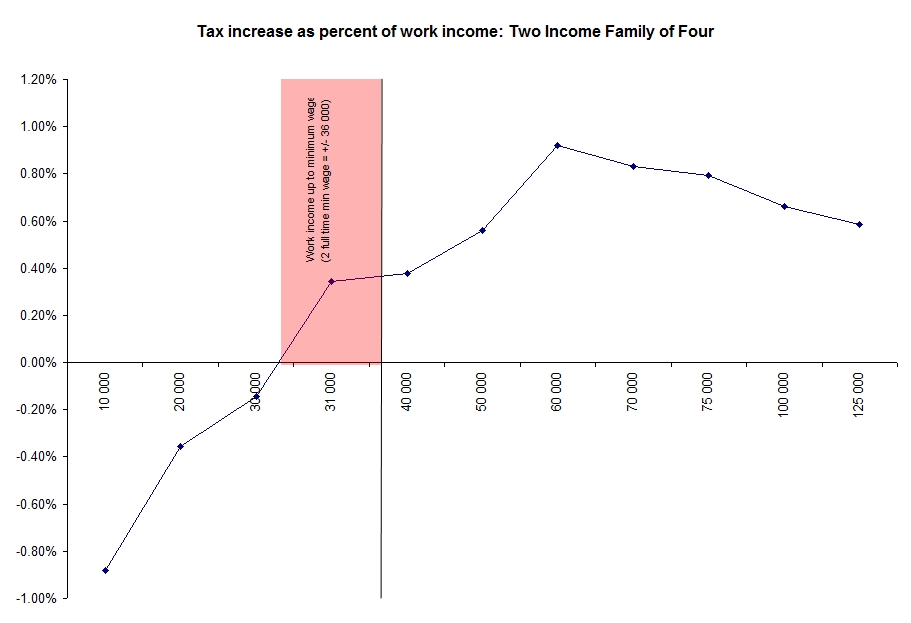
The working and middle classes are being made to pay for the dishonesty & mistakes of both Charest & Dexter. In Nova Scotia, those earning $34,800 - $83,000 will pay the increased HST, but get no progressive compensation, unlike those below them, rightly, and those above them, $83,000 - $150,000, wrongly. Dexter at least increases taxes on the highest bracket, 150+K, but continues regressive subsidies of wasteful anti-environmental behaviour. Charest at least raises Hydro rates & environmental taxes, a bit, with increased compensation for poor, but proposes introducing hideous regressive counterproductive health taxes, which, along with absence of tax hikes for rich, hurt poor, working and middle classes, while relatively benefiting the rich. Both Dexter & Charest favour business, and continue policies of effectively subsidising business through fiscal mix, relative to burden placed on individuals.

Charest's health taxes are more hideous than anything Dexter's doing, but that says something about just how bad they are, when Dexter & NDP are giving a tax cut to themselves and all MLAs & cabinet ministers in the upper middle class. Normally, that would be hard to beat, as far as stupid & bad fiscal policy, but Charest found a way (in latter table, compare tax paid by someone earning $125,000 vs. $15,000).

It is weird how they are both picking on the working & middle classes, who form the great majority of the electorate. Both intimidated by rich & business? Brainwashed? Full of shit themselves?

At least Nova Scotia budget means that in next Federal election, all non-NDP parties, especially Liberals, will profit from anti-NDP protest vote: a lotta seats to be won from NDP in Nova Scotia. Maybe Elizabeth May should come back. And also, subsequent provincial election will probably be Liberal minority, under excellent leadership of Stephen McNeil, who got his response exactly right (he sounds like Obama vs. Bush tax cuts, actually):
McNeil said creating a tax break for the well-off isn't fair especially when there is nothing for the middle class to offset the two-per-cent HST hike.

"I don't believe I should have gotten a tax break. At the same time, I'm looking in the eyes of people who sit in front of my desk who can't make ends meet, who are being told, 'Suck it up, pay the extra two per cent in HST and we're not going to help you','" McNeil said this morning.

There is a new tax credit for households earning less than $30,000. They'll get $240 a year, plus $57 per dependent child. The amount decreases for people making up to $34,800.

McNeil said that's still a low income.

"You tell me how someone lives on that," he said. "I've done it."

"I wonder if any of them (cabinet ministers) have ever been hungry? I'm going to tell you, there are a lot of Nova Scotians who are hungry and what they got yesterday was nothing more than their nose rubbed in it by this government who turned around and gave those of us who sit in the House a tax break. That is fundamentally wrong."

Cabinet ministers make $47,608.72 on top of their MLA's salary of $86,619.01, a total of $134,227.73. McNeil makes the same, as does House Speaker Charlie Parker.

Premier Darrell Dexter will also get the income tax break. He earns $109,484.76 in addition to his MLA pay, a total of $196,103.77.

The Strange 83-150K NS NDP Tax Cut Explained

"High-income surtax cut for >$83k/yr income. It's great to see $83,941.86 salary next to MLA's in Public Accounts. Thanks @NSNDP. #nsbudget", from Greg Lawson. No idea who he is, but that's a good point, and illustrates economic incoherence and political ineptitude in one stroke. In a province that has gone through massive unending political scandals about MLAs' feathering their nests, this is the brilliant tax cut given by the NDP in their big budget? Genius.

Also three good points from Andrew Younger MLA:
# Many of the working poor don't get a tax rebate in the NDP budget #nsbudget #nspolitics about 5 hours ago via UberTwitter
# Cabinet ministers get a tax breal in the NDP budget by dropping the surtax and middle income folks in Nova Scotia will pay more #nspolitics about 5 hours ago via UberTwitter
# The Tories say they managed the province's finances well in gov't, and the NDP say they are managing them well now - it is April Fool's Day 9:38 AM Apr 1st via UberTwitter

Silver Called It: NS NDP = Incoherent Economics, Despicable Political Ethics

I've never forgotten Silver's awesome dissection of the NS NDP's, uh, platform?
Maybe, platform is far too expansive a term given that the N.S. NDP's entire plan for government - and they do, by all accounts have a shot at forming government - is four pages (PDF) including glossy pictures, the "costing" of their "plan" and pictures of ordinary, average voters (some of them sitting at their kitchen table). (...) Of course if you flip to the front of the platform (back to page one, hope your wrist isn't tired yet), you will see that the NDP has actually promised to provide 1,000 grants for home retrofits. That's THOUSAND - singular - not THOUSANDS of homeowners. Not only is their platform beyond vapid. Not only do they do the single worst thing they could do for climate change. The FOUR pages are internally inconsistent.
It's a natural evolution from an incoherent four page platform to a dishonest, incoherent budget, I guess. I'll be curious to see how Totters respond to the NS NDP Budget, esp. those who have most ranted about the HST.

Putting aside politics and ethics for a second, economically, I've seen worse budgets, but the NS NDP budget is deeply incoherent. The HST rise, compensated with increased credits for low-income, is good, as is increased tax on 150+K. Bad is decreased tax on 83-150K - incoherent. Also, if deficit is the thing, why cutting corporate taxes? And by so little? I strongly disagree with corporate tax cuts, I would raise them, along with everyone else - everyone should have to do their part to stop deficit, corporations & individuals, on progressive basis, though. But if going to cut corporate taxes, to draw/keep business based on empty Reagan-Bush-Republican supply-side mythology I guess, since no empirical evidence, then that logic dictates massive corporate tax cuts, cutting minimum wage, etc. as one pursues a Duplessis-Alabama strategy. You've got to go big: can't half prostitute oneself. Half a point just irritates taxpayers compared to their own situation, and does nothing to draw investment. Also, should have raised gas tax, and all environmental taxes, with credits/compensation on progressive basis. Why are they keeping the energy rebate for everyone? That is regressive and anti-environmental! Eliminate it, make everyone pay market rates, and compensate them on a progressive basis.

The ethics and politics of this budget are atrocious, breaking their word so baldly, so quickly, and with such regressive and anti-environmental measures mixed in. Stupid Totters. And as far as crafting a decent political message, who thought it would be a good idea to give corporations tax breaks and subsidise wasteful anti-environmental behaviour while raising taxes on individuals? It wrecks the whole narrative. If you say "tough times, we're in it together", that can work. But then EVERYONE HAS TO PAY, ON A PROGRESSIVE BASIS. Old politics. Gives a bad name to all politics. Means a half-decent budget will be hated as exposes NDP campaign as complete lie, predictably. Sad. Probable minority Government for someone else next time. Hope it's the McNeil & the Liberals, they ran a mostly coherent campaign last time: fairest, most honest and best.

Calgary Grit
asked what gives with tax hikes and politicians, these days. I find myself in the odd position of agreeing with Josée Legault's analysis, in some respects (she's always mesquine & usually deranged). People support smart & fair taxes (McGuinty's health tax and seems to have won debate on HST). They oppose unfair, stupid taxes. Why? Because they make the connection between taxes and services, and fair and unfair. Why: more connected, more informed public than ever. When Charest cut income taxes after receiving "fiscal imbalance" funds, a strong majority disagreed, would have preferred money kept in services. They now disagree with his proposed substitution of regressive flat health taxes for progressive income taxes. People get it, more than ever. BS less useful, even counterproductive nowadays (unless in our particular 5 party federal environment, which promotes narrow-casting and thus demagoguery).

PS. I just realised that the NS NDP have also hidden the fact they have de-indexed taxes in a small note at back, claiming inflation was insufficient to merit continued indexation. Nice. Colbert would be proud. That is a really dirty regressive trick.

Tuesday, April 06, 2010

More Health Care Is Better: OG Wisdom, Straight Outta 1999

Charles R. Morris's famous 1999 article, via Levant: "Given that healthcare is in fact a productive industrial sector, the “drain on the economy” issue really translates into the issue of competing priorities. If we don’t spend the money on healthcare what will we spend it on? Larger homes, bigger SUVS, better electronic games, faster food, or a missile defense system? However, a discussion of choosing to divert healthcare dollars to other sectors is a mere academic exercise. For as Morris (1999, p. 96) points out “policy wonks still treasure the delusion that we as a nation will somehow decide what share of resources should be claimed by health care, when the demographic facts have already decided it for us.”"

Morris via NCPA:
Within the next 25 years or so, according to recent estimates, health care could account for as much as 25 percent of spending in the United States (ed. note: Obamacare = less?). Spending trends in almost all other developed countries are headed in the same direction, although with a time lag. Author Charles R. Morris asks, what is so bad about that?

Morris argues that health care is becoming a high-productivity, high-technology industry where each dollar buys more. Thus, although health spending is increasing, most health care costs are going down. And as the personal computer industry shows, falling costs and improved performance usually induces more spending, not less.

The share of national income devoted to food and health care combined hasn't changed in 50 years, says Columbia University economist Sherry Glied. We just spend a lot less on food, and a lot more on health care.

There is lots of literature out there on this basic point, I recommend U.S. Health Care Spending In An International Context, notably the section Health Care In The Macro Economy, which everyone should read. I'll just quote this:
the fact that in most industrialized countries health care has absorbed an ever-increasing fraction of GDP while other types of output—for example, agricultural products — have claimed a decreasing share does not by itself imply an excessive allocation of resources to health care.

The alleged economic burden of health spending
.
How serious a problem, if it is one at all, is the inexorable growth of health care as a component of GDP? On this question the responses of policymakers can vary, depending on their political purview. At the local level, policymakers usually give much weight to the employment opportunities offered by a growing health sector, which leads them to resist reductions in or closing of local health care facilities. On the other hand, at the macroeconomic level, policymakers often view growing health spending with alarm, although added consumer spending on other goods and services—on SUVs or entertainment— invariably is viewed as a sign of economic health by both policymakers and the media. What explains these seemingly inconsistent views toward consumer spending?
And some crucial Cancon as a follow-up, from our own Finance Department, those well-known irrational spendthrifts, Health-care Spending: Prospect and Retrospect, with these vital points:
What conclusion can be drawn then about the sustainability of health spending? Again, it depends on how sustainability is defined. Some suggest that any category of spending that grows faster than GDP is problematic, since it could require reductions in the share of GDP devoted to other areas of spending. However, the structure of public spending has always evolved over time, and these changes have been affordable. For example, total health spending as a share of GDP increased from 7% to 9.4% between 1975 and 2001. At the same time, federal public debt charges came down from 6.6% of GDP in 1990-91 to 3.2% of GDP in 2002-03 (Figure 18). Future reductions in debt charges may be expected to create additional fiscal room.
(...)
The spending increases projected under 1990s enrichment ratios thus appear to be within the limits of sustainability from both fiscal and political perspectives. However, this could change with a swing in public opinion. Given the wide range of spending options that are fiscal feasible, discussions of sustainability ultimately become a question of public choice. Even very large increases in health spending as a share of GDP are technically feasible, provided citizens choose to devote an ever increasing portion of GDP to the health-care system and are willing to pay for its cost.
(...)
Our projections show sizeable increases in total (public/private) health-care spending as a share of GDP. However, total provincial-territorial government spending on health remains under 10% of GDP by 2040 under the scenario we consider to be a reasonable baseline. While it is impossible to predict the level of health spending increase that can be successfully absorbed, the increases projected under this baseline scenario may be considered likely to be sustainable on a couple of bases:
• historical perspective – the projected increase is well within the range of historical increases over the last 20 years;
• inter-provincial comparisons – figure 10 showed that the projected increase is within the range of existing provincial variation in spending.
It should be emphasized, however, that these projections alone provide only one measure of the sustainability of health spending i.e. the health spending-to-GDP ratio.
A more complete analysis could place the projections shown in this note in a broader fiscal framework that includes all government revenue and spending. Such a framework could be used to evaluate the long-term impact of increases in health spending on government budget balances and debt-to-GDP ratios by taking into account potential offsetting changes in other components of spending.

Monday, April 05, 2010

QC Budget: Excellent Unintended Pedagogical Effect, Allows Destruction of Right-Wing Myths

One good thing about this QC budget is it offers an excellent opportunity to destroy common myths about public finances, economics & health care which are propagated by numbskulls, sellouts & the self-interested. Case in point, on Thursday, le Téléjournal had an excellent report titled Health Care: the Unforeseen Consequences of Private Sector Involvement which "discovered", again, that, private health care costs more and is more inefficient, and distorts and worsens the system in the aggregate when introduced or provided in a parallel system, by all measures, care, efficiency & economics.

Previously, on Wednesday, during 24 heures en 60 minutes, Louis Gill won a debate between economists, pointing out that the budget would terrible for a great majority of the population and wondering why other measures weren't considered, like a tax on capital gains and negative speculative behaviour (ed.note: denounced by Keynes et.al., leading to Tobin et.al.): "In the case of the general distribution of income, those who benefit from a non-exempt or mildly exempt capital gains, and who can in one day cash in on stock options which profit them massively, are still, even today, not taxed on these sources of income."

Now even a business columnist for a right-leaning paper like La Presse is following up, in The Legal Tax Evasion of CEOs, with Michel Girard drawing a parallel between the regressive taxation proposed by Bachand & Charest and the already regressive treatment afforded CEOs when they cash in their stock options, paying the same Fed-Prov 29% combined taxation rate as those earning $20 000, thanks to Bachand-Flaherty. He cites the real-world example among many, five Montreal CEOs who since 2007 have pocketed a fabulous 160 Million Dollars by cashing in their stock options. At the Federal level they qualified for an 80 Million Dollar tax deduction, a 40 Million Dollar tax deduction provincially, with the result that on the income from this stock options, they saved 19 Million Dollars in Federal Taxes and 10 Million Dollars in provincial taxes. He concludes by asking Bachand, Flaherty & all those business types lecturing us on how everyone has to pay their part, how it is they haven't yet proposed eliminating this privileged treatment of stock options? Hmm, I wonder, eh?

Like any social liberal & social-democrat, I am more than happy for a free and open debate on these questions, as the regressive taxation types are always advocating. We'll debate it openly, as Gill did, and see who the public believes and trusts. No cheating, eh, since you regressive taxation types are so convinced of the rightness of your position. And since you're true believers in rational actor theory and the wisdom of markets, political as well as any other, to be coherent, you will be more than happy to abide by the decision of the rational decision-making Canadian public, won't you? You are all democrats, aren't you. right?

PS. QC Budget: Good educational graphs here

PPS. Reality vs Corporate Taxes (Spoiler Alert, Reality Wins):
First, “taxes typically represent up to 14 percent of location-sensitive costs.” Since corporate income tax (CIT) is only one of the taxes paid by business, it alone accounts for an even smaller percentage of costs. Therefore, changes in the CIT rate have very little effect on total business costs.

Second, Canada’s effective CIT rate is about 4 percentage points below the next lowest country (Holland) and about 10 percentage points below the other countries examined (see exhibit 5.10 on page 60 of volume I). So, Canada could raise its CIT appreciably and still have a lower CIT than our main competitors.

Third, Canada had the second-lowest costs overall. The current round of federal CIT cuts was introduced in the 2007 Economic Statement. Looking back before that, Canada had also ranked second in the 2006 Competitive Alternatives report (PDF). Apparently, the latest CIT cuts have not affected our overall ranking.
 (h/t Accidental Deliberations)